





















As we draw closer, the experience begins long before we pass through the convent’s gates.
The road unfolds gently through a landscape that seems to have been shaped by the passage of time itself. On one side, ancient stone, weathered and polished by centuries of history; on the other, a succession of deep greens cascading down the hillside until they meet a discreet river, almost hidden from view.
Its presence reveals itself only through fleeting glimpses of sunlight dancing on the water and the delicate sound of small waterfalls accompanying its endless journey.


There is an energy here that is difficult to describe. Light filters softly through centuries-old trees, casting ever-changing shadows across the landscape. The air feels lighter, the pace slower.The natural surroundings embrace us almost immediately, awakening a rare sense of tranquillity, as though nature and silence had found a perfect balance in this place.
It is at that moment that we begin to understand that Convento de Cabanas is not merely a destination, but a state of mind.
Before we even reach the convent itself, what might be described as a small “portal” appears along the way — a magnificent stone bridge gracefully crossing the stream that accompanies the property. More than a simple crossing, it becomes a silent rite of passage, an invitation to leave behind the noise of the outside world.
No matter how many photographs we may have seen, or how high the expectations we carry with us, nothing truly prepares us for the first sight of Convento de Cabanas.
There is an emotion that is difficult to translate into words when confronted with something that feels at once so monumental and so delicate.The grandeur of its architecture does not seek to impress; it simply exists, serene and timeless, as though it had always belonged to this landscape. The soft tones of its centuries-old walls converse harmoniously with the vibrant green of the climbing vines that embrace them, creating a perfect union between human craftsmanship and nature.


Light travels across the ancient stone with an almost poetic subtlety, revealing textures, shadows, and details that bear witness to centuries of history.
There is an undeniable presence to this place, a quiet majesty that asserts itself not through scale or spectacle, but through authenticity. For a few moments, the gaze inevitably drifts into contemplation. Silence seems to acquire a new depth, and everything around us invites pause and reflection. It is one of those rare places capable of inspiring awe without resorting to excess, where beauty resides precisely in the balance between the strength of its heritage and the serenity of its essence. My experience began in a different way. Perhaps because, from the very first moments, everything seemed to suggest that this would not be just another place to discover. There was something in the atmosphere, in the way the convent gradually revealed itself, that quietly hinted that everything here followed its own rhythm.
After passing through the gates, I chose to begin with the church. Discreet, welcoming, and meticulously restored, it presents itself without ostentation, remaining faithful to its essence and history. It is a space that naturally invites reflection, where beauty does not demand attention but slowly unveils itself through subtle details, soft light, and a serenity that seems to inhabit every corner.
And then, there was the sound.
A melody drifted through the space, accompanying each step with quiet elegance. Throughout my stay, music would become a constant presence — almost invisible, yet deeply felt. Not as a decorative element, but as an integral part of the experience. A presence that welcomes, comforts, and conveys a rare sense of peace. At that moment, the unforgettable composition by Ennio Morricone for The Mission, the extraordinary 1986 film starring Jeremy Irons and Robert De Niro, was playing. No choice could have been more fitting.


The film speaks of redemption, transformation, and the search for meaning. And in a way, I felt that my own mission here would also be particularly challenging.
How does one describe a place like this? How can words capture sensations that belong more to the realm of emotion than reason? There are experiences whose beauty transcends the limits of language. Places that touch us so profoundly that they escape any attempt at complete description.
Still under the spell of the church’s serenity, I find myself naturally drawn towards the cloister. At first glance, it does not impress through scale. It is small, discreet, and free from any aspiration to grandeur. Yet it is precisely within that restraint that its greatest strength resides. Some places do not need to be vast in order to feel immense in what they make us experience.
The ancient stone columns frame a space of perfect balance between architecture, spirituality, and nature. At its centre, a fountain adorned with the symbol of the Benedictine Order seems to quietly safeguard centuries of contemplation and devotion. Around it, vegetation flourishes with an almost organic naturalness, as though it had always belonged there, softening the stone and adding new shades of life to a space shaped by time.
And then there is the sound of water.
Or perhaps it would be more accurate to speak of the silence it creates. A constant, delicate, almost hypnotic murmur that seems to absorb every other sound in the world.
It is one of those rare paradoxes in which sound does not interrupt silence — it deepens it.
Sitting beside the fountain, watching the light slowly travel across the arcades and the shadows move gently over centuries-old stone, I realised that some experiences simply exist beyond the reach of language. We may describe them, we may approach them through words, but we can never fully capture the depth of the emotions they awaken.


The cloister of Convento de Cabanas belongs to that rare category of places that must be experienced in order to be truly understood.
The whirlwind of emotions continues. At Convento de Cabanas, every corner and every hidden nook seem to have been designed to awaken curiosity and nurture a constant desire for discovery. There are no prescribed routes or staged moments. The place reveals itself slowly, allowing each visitor to build their own relationship with the spaces, the sounds, and the memories that inhabit these centuries-old stones. The gardens now become the destination. Walking along discreet paths and through vegetation carefully integrated into the landscape, it is impossible not to notice the ancient stone walls covered in moss.
Their irregular surfaces preserve centuries of history, bearing witness to generations of monks, owners, travellers, and dreamers who have passed through this place. There is a profound beauty in these marks of time, an authenticity that no contemporary intervention could ever reproduce.
The sound of the waterfalls and the constant murmur of the river accompany us through almost every corner of the property. It is a permanent, almost invisible presence that blends with birdsong and the gentle movement of the trees. More than an element of the landscape, the water becomes part of the convent’s emotional identity, reinforcing the sense of tranquillity that envelops the entire property.
Among the many places that invite contemplation, the Rose Garden stands out, a former passion of the poet Pedro Homem de Mello, who found in this convent one of his most inspiring refuges. The delicacy of the flowers, the subtle fragrances, and the romantic atmosphere still seem to preserve something of his presence.
Nearby, an elegant wrought-iron structure, embraced by vegetation that slowly wraps around it, adds an almost cinematic dimension to the setting.
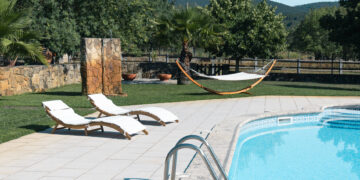
And then, the swimming pool.
Carefully positioned in one of the most privileged areas of the property, it appears as a natural extension of the landscape. From here, the gaze wanders across the nature that surrounds the convent in every direction. The view possesses a beauty that is difficult to describe, the kind that compels us to interrupt any conversation and simply contemplate.


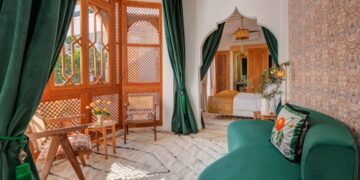
In many places, there is beauty. Here, there is something rarer: the perfect harmony between nature, heritage, and emotion. Discreetly integrated into the landscape, almost as though it had always belonged to the setting, stands a country house that accommodates two absolutely charming rooms. The architecture shows profound respect for the place in which it stands, never competing with the history of the convent or the beauty of the surrounding nature. Everything seems to exist in perfect harmony. Inside, every space is a celebration of serenity. The décor combines authenticity, comfort, and aesthetic sensitivity in a rare way.
There is no excess whatsoever, only a succession of carefully chosen details that immediately convey a sense of well-being. These are rooms that invite guests to slow down, to read beside a window open to the gardens, to listen to the sounds of nature, or simply to appreciate the privilege of being present in that moment.
Still within the gardens, yet in the historic heart of the convent, there is a third room equally deserving of admiration. To step into this space is to discover a narrative built through objects, textures, furniture, and memories.
The décor possesses an almost emotional dimension, where every element seems to have been chosen not only for its beauty, but also for the story and the sensations it carries. What is most impressive about these three rooms is the evident dedication of those who conceived them. They are spaces created with love, sensitivity, and respect for the spirit of the place.
In every corner, one feels a genuine intention to preserve the soul of the property and to provide an authentic experience. And perhaps that is precisely why they are so moving. Because, more than rooms, they are refuges filled with character, capable of awakening memories, emotions, and a rare sense of belonging.
I return to the interior of the convent, although the truth is that I had never really left it.


Here, the spaces communicate naturally with one another, like chapters of the same story. Still within the cloister, the eye is inevitably drawn upwards to the upper floor, where the architecture reveals one of its most elegant and poetic expressions. Between the ancient stone columns, the white sash windows create a composition of rare beauty.
Their panes reflect the deep blue of the sky and the various shades of green from the vegetation inhabiting the cloister, creating a constant interplay of light, colour, and reflections. For a few moments, it becomes difficult to tell where the architecture ends and the landscape begins. Everything seems to merge into a single harmonious image, carefully shaped by time.
There is also something almost musical about this perspective. The upper galleries seem to gently amplify the sound of the water flowing from the fountain, allowing its murmur to accompany every step and every glance.
Stone, light, vegetation, and water converse with one another in a silent language that requires no explanation. It is one of those unexpected moments that remain etched in memory. Not because of its grandeur, but because of its ability to make us stop.
Simply stop. Observe. Listen. Feel. And understand that true beauty rarely seeks attention; it simply exists, quietly and perfectly in its authenticity.
On the upper floor, the experience acquires a new depth. Every room, every corridor, every corner, and every detail seem to exist in perfect continuity with the original architecture. Nothing appears as a forced intervention or an attempt to recreate the past. On the contrary, everything engages naturally with the history of the convent, as though the objects, pieces of furniture, and decorative elements had always belonged there.
It is here that the care, love, and dedication invested in the restoration of this property become particularly evident. In every corner, one senses a rare intention: that of preserving a soul rather than simply restoring a building. Rarely have I encountered a place where every element seemed to occupy exactly the right place. Even when it becomes apparent that a particular object did not originally belong to the convent, there is such a natural harmony that it becomes impossible to imagine it anywhere else.
As though it had merely been waiting for the right moment to arrive there.
This feeling carries with it a deeper reflection on the true meaning of luxury. Not the luxury of ostentation or abundance, but the rare luxury of time. The time that shapes stone, that matures ideas, that gives meaning to objects, and that allows everything to find its rightful place. Here, everything seems to have happened at exactly the right moment, without haste and without artifice.
This difficult mission was undertaken by Nathalie d’Ornano with truly extraordinary sensitivity.
To respect, simultaneously, time and space, memory and renewal, the sacred and the everyday, is an exercise of immense complexity. Yet the result reveals an almost invisible elegance, the kind that only the most authentic places are capable of conveying.
On this floor are three magnificent rooms. And it is precisely here that I am compelled to confess a certain sense of helplessness as a writer. There are places whose beauty challenges language itself, spaces where words always seem insufficient when faced with what the eyes observe and the heart feels. These rooms belong to that rare category.
There is something profoundly cinematic in the way light passes through the windows throughout the day, casting soft shadows across the walls and slowly revealing the richness of the materials and textures.The blue-painted wooden ceilings, possessing a serene and unexpected elegance, converse with the ancient stone, creating a perfect balance between delicacy and character.
Once again, every detail seems to have been conceived not merely to be beautiful, but to evoke emotion. As I observed the room, I came across an object that, in a way, helped explain what I was feeling.
On a table lay a copy of the score of Ride of the Valkyries, the celebrated prelude to the third act of Die Walküre by Richard Wagner, one of the works that form part of the monumental cycle Der Ring des Nibelungen. Its presence struck me as anything but accidental. There is within that composition a majestic power, an emotional intensity, and an epic dimension that, in a curious way, echoed the sensations awakened by this place.
As if that were not enough, resting on the bedside table was a copy of The Art of War. Another seemingly simple object, yet one laden with meaning. It was then that I understood that nothing here is left to chance. Every book, every decorative piece, every work of art, and every aesthetic choice contributes to a larger narrative.
This is not merely about decoration; it is about creating dialogue, reflection, and discovery. Convento de Cabanas constantly challenges the senses. Not through excess or display, but through the intelligence, culture, and sensitivity with which each space has been conceived.
Here, every room is more than a place to sleep. It is an emotional, intellectual, and aesthetic experience that remains with us long after the door has been closed behind us.
I pick up the copy of The Art of War, one of the books that has accompanied me most often throughout my life, and make my way to one of the most extraordinary places on the entire property.
A magnificent stone balcony extends over the river, allowing the landscape to be contemplated while the water sings softly as it passes between the rocks. The sound is constant, almost hypnotic, like a melody composed by nature itself.
What an utterly idyllic corner.
I sit down. I open the book. I read a few lines. Then I close it again. There are moments when reading gives way to contemplation.
I close my eyes and allow myself to be enveloped by the atmosphere of that place, trying to attune myself to all those who sat there before me, seeking to understand what repeatedly drew them to that exact spot in the house. It would not take long for me to discover that this was also the favourite place of one of the most extraordinary figures in Portuguese culture: our Amália Rodrigues.
An emotional heritage of an entire nation, a timeless voice and a singular presence in the history of Portugal, Amália was a frequent visitor to Convento de Cabanas. The connection came through Pedro Homem de Mello, then owner of the convent and one of the most important Portuguese poets of the twentieth century, author of several lyrics that would become immortal through the voice of the fado singer, among them Havemos de Ir a Viana and Cuidei Que Tinha Morrido.
Sitting on that balcony, I understood that some places preserve more than memories. They preserve presences. Not in the physical sense of the word, but in a more subtle and difficult-to-explain dimension. People leave, but something of their energy remains in the spaces they loved, in the places where they found inspiration, happiness, or peace.
In that moment, between the murmur of the water, the beauty of the landscape, and the surrounding silence, I had the strange feeling that Amália remained, in some way, connected to that place. Not as a distant memory, but as a luminous presence that still inhabits its corners. Because if there is one thing we associate with her voice and her personality, it is emotion. And emotion is perhaps what best defines Convento de Cabanas. It is in the stones, in the gardens, in the music, in the water, in the light that passes through the windows, and in the serenity that envelops every space.


It is present in every corner of this convent, which continues to embrace not only the history of those who passed through it, but also the invisible beauty of their memories. Night slowly falls over the convent and, with it, a new serenity arrives. The whirlwind of emotions that accompanied each discovery throughout the day finally begins to settle, not because it disappears, but because it finds its place.
The golden light gives way to the soft shadows of the evening, the sound of the water remains ever-present, and the convent acquires an even more intimate and contemplative atmosphere. It is then that the experience leads us to Magnólia, the restaurant housed within the convent’s former wine cellar.
And, almost inevitably, we encounter once again what has become a signature of this place: discreet elegance, luxurious minimalism, and a rare ability to create deeply emotional environments without resorting to excess.The ancient stone walls, carefully preserved, envelop the space in a welcoming and almost cinematic atmosphere. Soft lighting highlights textures, volumes, and architectural details, creating a setting where past and present coexist in perfect harmony.
Everything invites us to linger a little longer, to extend the conversation, and to savour the moment without haste. The gastronomic concept follows the same philosophy found throughout Convento de Cabanas. A genuinely farm-to-table approach, where local produce, seasonality, and respect for ingredients take centre stage. There are no unnecessary artifices or excessive displays of creativity. There is only a profound understanding of the ingredients and a sincere desire to honour the region through gastronomy.
Each dish tells a story of proximity, authenticity, and connection to the land. The flavours are pure, balanced, and elegant, allowing the ingredients to express themselves in their truest form. The result is a memorable gastronomic experience, not only because of the quality of the cuisine, but also because of its absolute coherence with everything the convent represents. Because dining at Magnolia is not merely a meal. It is the natural continuation of a journey shaped by beauty, history, culture, and emotion.
An experience that is difficult to forget and one that, without hesitation, I consider absolutely unmissable for anyone visiting this extraordinary place. Sleeping in one of the rooms at Convento de Cabanas is an experience that defies any attempt at description. There is a moment, just before falling asleep, when the silence of the night settles completely and all that remains is the distant sound of water making its way through the darkness. The light slowly disappears from the centuries-old walls, the outlines of the architecture dissolve into the shadows, and we experience something that is becoming increasingly rare in the modern world: a profound sense of peace.
Waking up is equally unforgettable.
Even before opening our eyes, the senses begin to recognise the new day. The aroma of freshly baked bread drifts discreetly through the corridors, mingling with the delicate fragrance of flowers freshly placed on the breakfast table. There is something deeply comforting about these simple, almost domestic gestures, which make us feel not like guests, but like visitors welcomed into a very special home.
Guided by these aromas, I arrive at the extraordinary Blue Kitchen. And once again, the convent manages to surprise. More than a place to have breakfast, it is a space filled with identity, memory, and emotion.
The blue tones, the soft morning light reflected across the surfaces, the carefully chosen objects, and the welcoming atmosphere create a setting of rare beauty, where time seems to move more slowly. Sitting at the table, I realise that true hospitality cannot be learned or replicated. It is something that is felt. And here, it is felt in every detail. In the way we are welcomed, in the quiet generosity of each gesture, and in the care invested in every element of the experience.
The Blue Kitchen interprets the essence of Portuguese hospitality masterfully and, in particular, the soul of Northern Portugal. A hospitality built on authenticity, human warmth, generosity, and a unique ability to make those who arrive feel immediately at home.

Perhaps that is the secret of Convento de Cabanas. Its beauty is undeniable, its history extraordinary, and its spaces absolutely memorable. Yet what truly remains in the memory is something more difficult to define: a sense of genuine welcome, a quiet emotion, an inner light that stays with us long after departure.
After breakfast, I allowed myself to be guided by curiosity and the desire to discover everything that lies beyond the convent walls. And once again, nature assumed the leading role. Green. Green everywhere. Deep greens, luminous greens, vibrant greens. Water appears constantly, sometimes in small streams hidden among the vegetation, sometimes in waterfalls that seem to emerge from the mountain itself.
Every path leads to a new corner, every bend reveals a new landscape, as though the territory had been designed to reward those who explore it without haste. It was in this way that I discovered Café de Cabanas. A place that seems to belong to another era, where time slows down and gestures recover their simplicity.
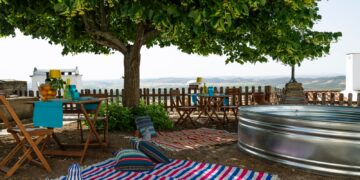
Sitting in that romantic garden, surrounded by lush vegetation, among tables and wrought-iron chairs delicately integrated into the landscape, was yet another of those experiences that are difficult to forget.
There is a quiet beauty in that space, a natural elegance that requires no artifice. I could continue speaking about the paths, the gardens, and the small discoveries that await those who venture beyond the convent grounds. I could speak of the pilgrims walking the Camino de Santiago who find here a moment of rest, welcome, and renewal. I could describe the sounds, the aromas, the light, and the emotions that accompany every step.


But I confess to a certain “selfishness.”
There are places that deserve to remain partially undiscovered. Not for lack of words, but because some experiences lose part of their magic when explained in too much detail. Convento de Cabanas is one of those places. No matter how much is written, no matter how carefully it is described, no narrative can ever replace the experience of truly being here.
So perhaps the best advice I can offer is simple: come.
Walk these paths. Listen to the water. Breathe in the fragrance of the gardens. Observe the light upon the ancient stone. Sit quietly beside the river.
Allow yourself to experience this place with all your senses.
As I prepare to leave, I find myself trying to organise the memories of these days. The stone bridge that seemed to lead to another world. The incessant murmur of the water. The cloister bathed in an almost sacred light. The windows reflecting the blue of the sky and the green of the gardens. The rooms where every object seemed to possess a story of its own.
The balcony over the river where Amália’s presence still seems to inhabit the silence. The aroma of freshly baked bread in the Blue Kitchen. The gardens, the roses, the waterfalls, the hidden paths, and the serenity that reveals itself in every corner.
Yet, as I reflect on all of this, I realise that Convento de Cabanas is far more than the sum of its spaces, its landscapes, or its architectural beauty. What truly remains is an emotion that is difficult to explain. A feeling of reconnecting with something essential that we so often forget amid the pace of contemporary life. Here, we learn once again to observe.
To listen. To feel. To respect time.
Perhaps that is why this place has such a profound impact. Because it was not created to impress. It was created to preserve. To protect a collective memory that belongs not only to a family or a property, but to all of us. To the history of a region. To the identity of a people. To the soul of a country.


We live in an age in which things are so often demolished in order to build a new. That is why it becomes even more valuable to encounter people capable of dreaming differently. People who choose restoration instead of erasure, preservation instead of replacement, care instead of transforming everything into something disposable.
It is an act of immense generosity towards the past, but also towards the future. Because the most beautiful legacies we can leave to future generations are not merely buildings. They are memories, stories, identity, culture, and beauty.
Throughout this visit, I came to understand that every stone, every garden, every book, every flower, and every object placed within this convent carries an intention. Nothing was done out of obligation. Everything was done with love. And perhaps it is precisely that love which we constantly feel as we move through these spaces.
A profound love for history, for art, for nature, for Portuguese culture, and for the ability of places to transform us.
There are extraordinary hotels. There are magnificent properties. And then there are places that remain with us long after the journey has ended. Places that stay with us in silence, returning to our memory long after we have departed. Convento de Cabanas belongs to that rare and precious category.
And so, these final words are not merely a conclusion. They are a gesture of gratitude.
Thank you, Nathalie d’Ornano.
Thank you for dreaming when it would have been easier to give up. Thank you for listening to the voice of these centuries-old stones and for giving them a future without taking away their soul.
Thank you for preserving such an important fragment of Portugal’s memory with truly extraordinary sensitivity, respect, and care.
There are places that welcome. There are places that inspire. There are places that transform.
Convento de Cabanas manages to do all three at the same time. And that is one of the rarest luxuries a traveller can find.
….
Photo Credits: @conventodecabanas – Cover by @conventodecabanas
Contacts and Location
Convento de Cabanas | Caminho do Barroso 63, 4900-012 Afife, Portugal
Telephone | (+351) 939 951 525 (call to the Portuguese mobile network)
Email | contact@conventodecabanas.com
Instagram | @conventodecabanas
Website | www.conventodecabanas.com
BOOK WITH BEST PRICE (click in best price)