





















Instead of seeking polished and immaculate perfection, wabi-sabi finds harmony in asymmetry, the unfinished, the rustic, and the imperfect — elements that tell stories and carry character.
We live in hurried times, marked by a constant pursuit of the ideal, of flawless brilliance, of unattainable perfection. In this insatiable quest, we often forget the serenity that dwells in simplicity, in the unfinished, and in the marks left by time.


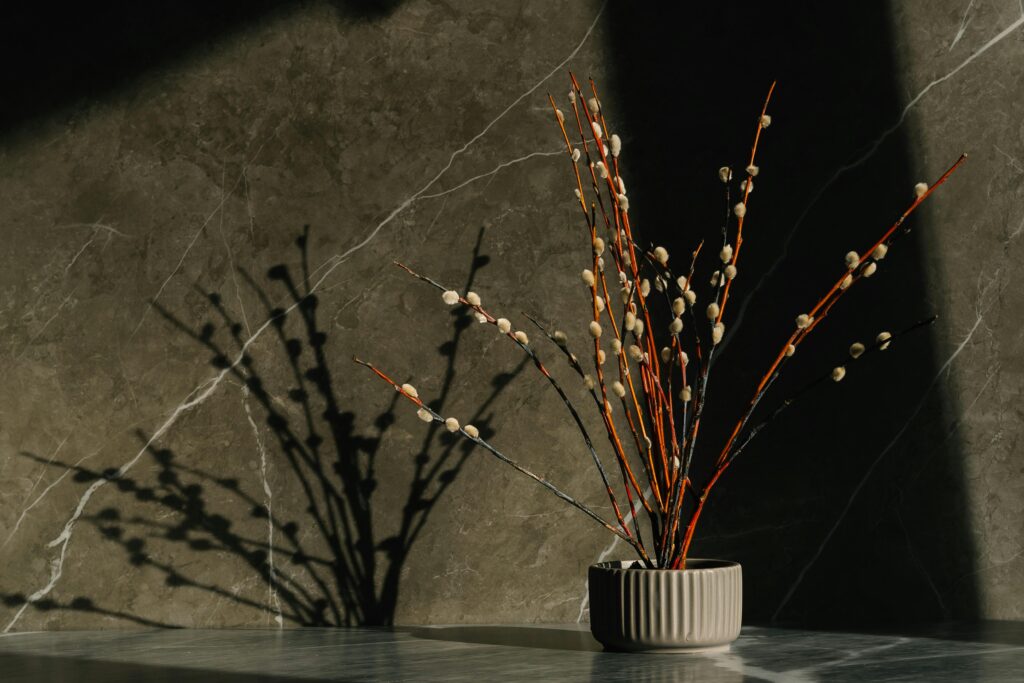

It is within this discreet, almost whispered space that wabi-sabi is born — a Japanese aesthetic philosophy that invites us to look at the world, and at life, with gentler eyes and a more open heart.
Wabi-sabi is not merely an artistic or decorative trend, but rather an attitude, a way of understanding existence. It values what is imperfect, fleeting, and incomplete.
It finds beauty in weathered wood, in cracked ceramics, in worn linen, in the silence of a room where light gently dances across walls marked by time. A home inspired by wabi-sabi does not require luxury, nor objects perfectly aligned by convention.


What it truly needs is soul. Pieces that tell stories, materials that carry the echo of the hands that shaped them, spaces that breathe and embrace. It is a refuge where matter converses with spirit, where every imperfection is an invitation to contemplation and gratitude.
By embracing wabi-sabi, we choose to live with less noise, with fewer excesses, and with greater meaning. We come to understand that beauty lies not only in what shines, but above all in what endures, in what transforms, and in what holds the memory of time.
Ultimately, wabi-sabi is about accepting life as it is — imperfect, transient, and profoundly beautiful. It is an invitation to slow down, to notice the small gestures, the textures of matter, the silences we share. Because, at times, what is most precious is not what we see, but what we feel.
And perhaps this is the most beautiful lesson this ancient philosophy has to offer us: to learn, with a whole heart, to see the beauty that lives within imperfection.